Women-led Ecological Pluralism or Dehumanization and Political Feminicide? – Why Defend the Democratic Autonomous System in Northeast Syria
During the first months of 2026, life in the area known as DAANES, the Democratic Autonomous Administration of North and East Syria, has been threatened. DAANES, commonly known as Rojava, has become known for its attempts to build a society based on women’s liberation, ecology, and democracy.
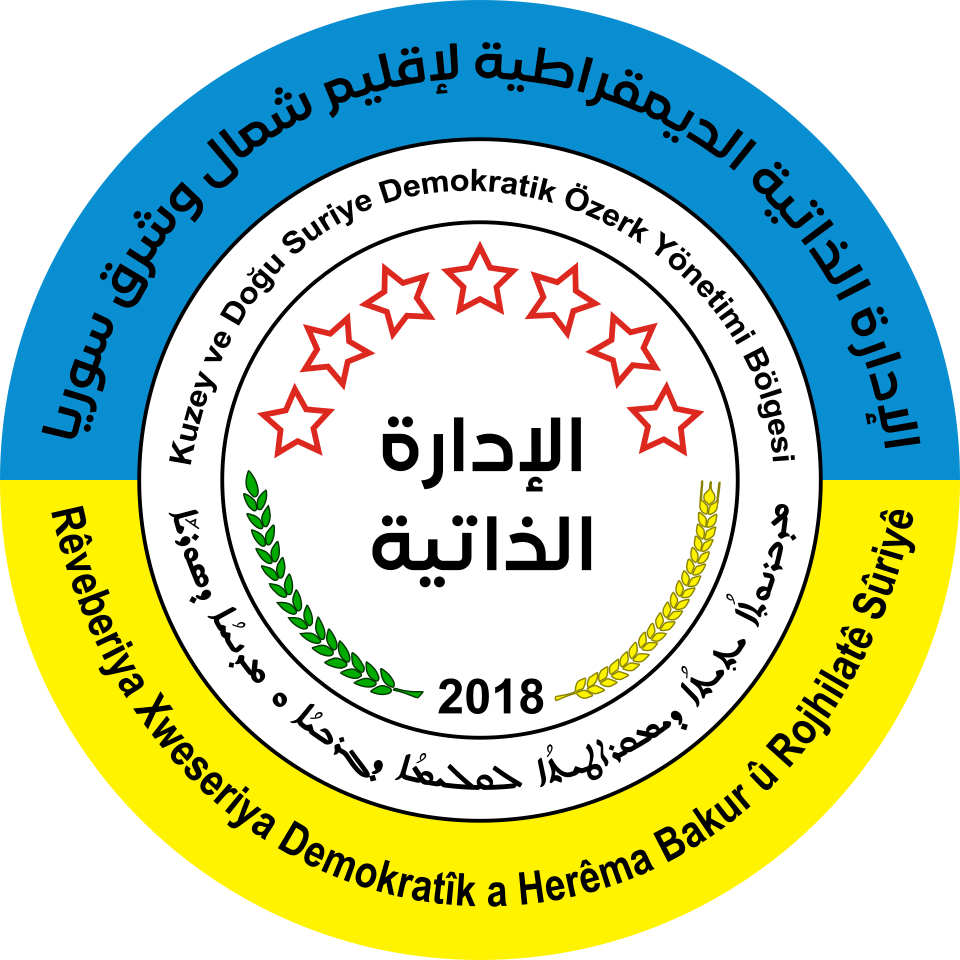
While both Rojava and DAANES are used as names of the area, they carry different meanings. DAANES is used officially. The name ’Rojava’ in turn means ’West’ in Kurdish – the initial autonomous area was a Kurdish-majority area. Rojava became famous in the West for its all-female defense units. The YPG and YPJ, the people’s and women’s protection units, defeated the Islamic State (IS) with the help of the US. In the process, Arab-majority areas were liberated from IS rule. As the autonomous area grew, there was a process of changing the name to represent all groups. The name thus changed from Rojava to the latest version DAANES. Also the defense forces grew and became the SDF, the Syrian Democratic Forces. The pluralist and multilingual reality is further reflected in the area’s flag, or symbol, displaying several languages.
Different paths can be taken to analyze and describe the threat, and for a shorter explanatory article such as this one, I will focus on recent events. However, the area and its ideological foundation have faced attacks from multiple sides over many years, most notably from the Turkish state. Now, more clearly than before, attacks are supported and facilitated by the EU and the USA.
Questions have been posed as to what Rojava is, what is happening in the area, and why scholars of critical animal studies or gender studies should be interested in these developments. This article aims to briefly contextualize what the area means both theoretically and practically, and for whom. First, I will introduce the theoretical framework together with its practical implementation. Then I will describe the current geopolitical situation and discuss the use of animalization, dehumanization, and gender-based violence in recent events. Finally, I will describe the resistance and solidarity that the current state has brought about.
Democratic confederalism as a theory
DAANES and the ideas behind it are based on so-called democratic confederalism, and it operates as a kind of direct democratic system (Knapp, Flach and Ayboga 2016). It is an attempt to build a pluralistic society that recognizes different ethnic, language, and religious groups. This differs from the structure of the nation-state in that decision-making takes place in a more decentralized manner, although it works within state structures.
The theoretical framework builds on the political analysis and writings of Abdullah Öcalan, the imprisoned leader of the PKK (the Kurdistan Workers’ Party). It is the result of a longer process of discussion within the Kurdish freedom movement, as explained by Kurdish political sociologist and activist Dilar Dirik (2022, 56‒57). Öcalan built on, amongst others, the political philosophy of Murray Bookchin, who emphasizes direct participation in decision-making, ecology, and a critique of hierarchies. In his writing, Öcalan presents a theory and a practice that center women, ecology, and democracy. It is, however, impossible to summarize the ideas here, as they are presented in a vast body of work.
Both the theory and the practice of democratic confederalism could be of interest to scholars of critical animal studies. While not presented as a central part of the theory, Öcalan analyzes the killing of non-human animals as a foundational aspect of the creation of hierarchical relations between humans and as a reason for war (Öcalan 2023, 26–27). This multi-species aspect of his work could be further studied and built on. So far, non-human animals and multi-species relations have not been centered in reports or analyses regarding NE Syria. Since the field of critical animal studies concerns itself with theory, practice, and social change, there are some interesting lessons that can be learned from this theoretical framework, as well as its practical implementation. Furthermore, according to Mees M. J. van der Borgt, an anti-nationalist form of veganism practiced in Bakur, the Kurdish part of the Turkish state, seems to originate from an “active site of the Kurdish struggle” on the shared border of the Turkish state, Iran, and Iraq (van der Borgt 2023, 30). This anti-nationalist veganism might interest scholars of critical animal studies, as well as researchers engaging with ecofeminism and sustainable food practices.
Democratic confederalism in practice
In DAANES, democratic confederalism is implemented in practice, however imperfectly. In the region, as well as globally, such a non-state project centering women’s freedom is unique. Before the Arab Spring in 2011, the civil war of 2012, and the later rise of IS, the area of DAANES was under the military dictatorship of the Baathist regime (Knapp, Flach and Ayboga 2016). Currently, the de facto government of Syria, supported by the US and the EU, is mainly maintained by jihadists. Both ways of governing have focused on centralized rule.
DAANES does not strive for independence, which differs from many other anticolonial liberation movements. The late anarchist anthropologist David Graeber has described Rojava as being similar to the worker-led social revolution in pre-civil-war Spain. He has also described Rojava and democratic confederalism as having been inspired by the Zapatistas in Mexico (Graeber 2014).
In DAANES, the representation of women in decision-making is extraordinary. There is co-leadership in all administrative institutions, meaning that there is one woman and one man in leadership positions. Thus, women are represented in decision-making in all sectors of society. Co-leadership ensures that decision-making regarding, for example, economic matters and infrastructure does not fall exclusively into the hands of men.
There are active women’s civil society organizations, recognizing the differences and specific needs within ethnic and language groups. So-called women’s houses, where people can get help, for example, with family issues, have been established. A women-only village called Jinwar, where women and children live and make a living, has been built (Cioni and Patassini 2021). The defense forces include the women-only Women’s Protection Units (YPJ), and there is the so-called ’asayish’, which functions as a kind of police and includes women. Furthermore, there are the Civil Defense Forces (HPC), composed of volunteers guarding their communities (RIC 2024).
Furthermore, universities have been established. These universities teach in Kurdish, creating a higher education environment for students and academics alike in an area where the Kurdish language had previously been forbidden within the educational system (Schmidinger 2017, 67). It includes the teaching of jineolojî, or women’s science, at the university level (Dirik 2022, 76). Universities also teach in Arabic.
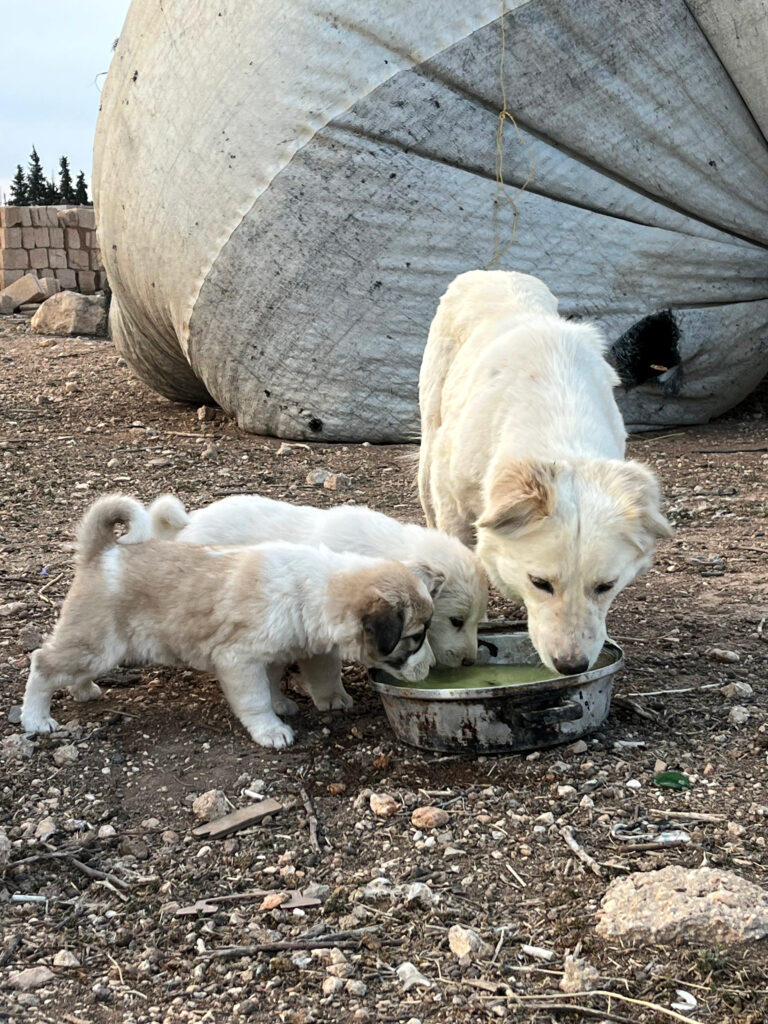
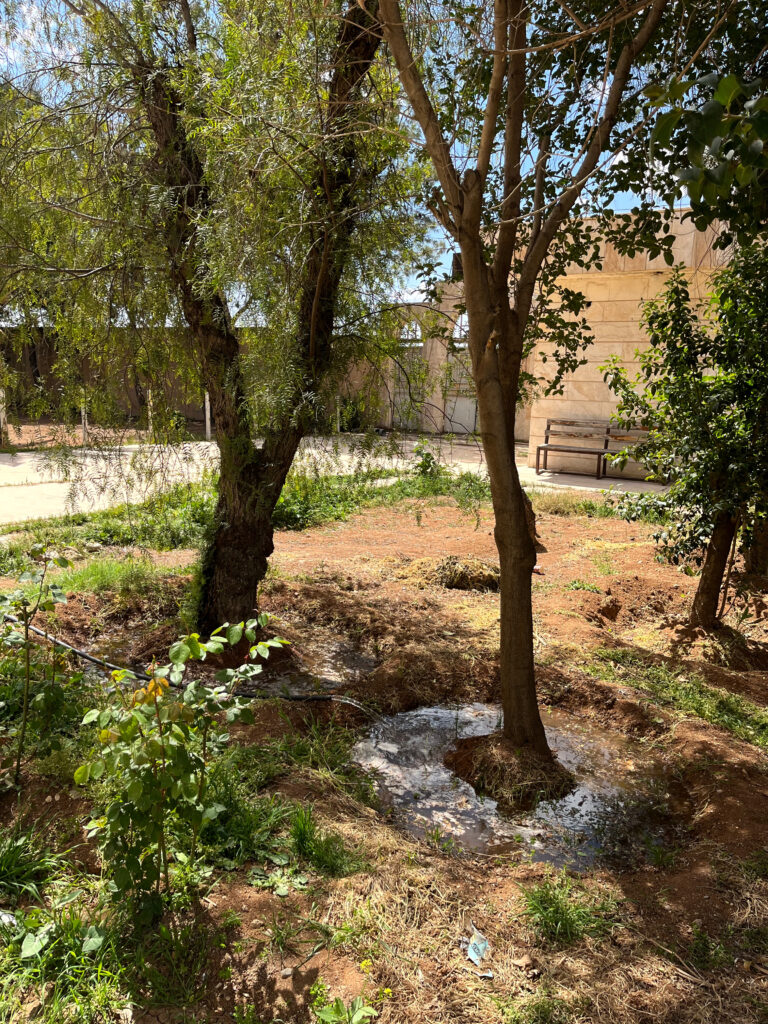
While the role of women in decision-making and societal structures is well documented, ecological efforts are not as prevalent and have not gained as much attention. There is, however, a focus within the universities and different organizations on, for example, preventing desertification and climate change. Green Tress is one of the local environmental organizations. In May 2025, scholars from the Rojava University and Green Tress presented their work in a joint online seminar, organized by the Rojava University, the Network for Critical Animal Studies in Finland, and TYKE, the Turku Human-Animal Studies Network, operating at the University of Turku, Finland. Green Tress talked about, among other things, the organization’s animal welfare committee. The committee works with stray animals under conditions where there are no animal shelters. The organization also plants trees: the area has been used for logging and monocultural intensive farming, and very few trees remain (Knapp, Flach and Ayboga 2016, 212). Like the Rojava University, Green Tress works with a large number of internally displaced persons. In this situation of extreme pressure and war, international solidarity has been asked for (CSUA-Paris).
As the system is not based on the idea of the nation-state, a multitude of challenges appear. These are not only practical local problems but also global structural problems that lead to not recognizing non-nation-state ways to organize society. For example, the University of Rojava is not accredited within the state system, which leads to challenges since graduates’ degrees are not recognized anywhere else (RIC 2022). International collaboration, vital for both research and learning, is needed (Dialogue for Change 2025).
There are also shortcomings and difficulties in establishing such direct democracy, as described, for example, by anthropologist Axel Rudi (2022). What is important is that it is a local and ambitious project that creates pockets of hope in a time of global war, genocide, ecocide, and devastation.
At this moment, the project of democratic confederalism in NE Syria is threatened. Areas that a month ago considered themselves DAANES are now under Syrian regime control. The current transitional government is a de facto government that has not been brought to power through democratic elections. It consists mainly of self-proclaimed Islamists who, in the name of centralism, promote fanaticism and create division based on ethnicity and religion. Mainly Kurdish people live in the remaining area of DAANES, and also Armenians, Arabs and Assyrians are among the different ethnic groups inhabiting the Northeast (Schmidinger 2017, 13). Religious minorities include Christians and Yazidis.
Due to the arrangements made by global and regional powers, mainly the US, the Islamist group Hay’at Tahrir al-Sham (HTS) took over, swiftly and almost without fighting, land areas in Syria and eventually entered Damascus in December 2024. The HTS was initially formed as an offshoot of al-Qaeda. The terror rule by former president Bashar al-Assad was over. However, the new transitional government soon continued terrorizing different groups of people. Aside from the acts of identity-based killings and the expulsion of people from their homes (Zayadin et al. 2025), in spring 2025, the transitional government forces massacred 1500 Alawites (Michael 2025). In late summer 2025, the Druze community in the south of Syria faced a similar fate (SyriaHR 2025). The area of DAANES, home to Kurds and other ethnicities, still held autonomy and a relative state of calm. However, it was only a matter of time before the area would face a military attack. During its time in power, the interim government has expressed fierce anti-Kurdish sentiments in media and society.
Since the beginning of January 2026, there have again been attacks by the Syrian Transitional Government (STG), former HTS, starting with massacres in the two Kurdish neighborhoods in Aleppo. Different numbers circulate of how many people have had to flee, some mentioning up to 170,000 internally displaced people (Rudaw 2026). STG and affiliated gangs then took the cities of Tabqa and Raqqa. From the south, they entered the city of Deir ez Zor and started to move north towards the infamous al Hol camp containing IS families. News circulated about the release of IS prisoners by the STG forces. Furthermore, the significant city of Kobanê came under siege. Kobanê is known as the city that defeated IS in 2014.
In their military campaign, the STG is largely supported by the Turkish state and the US. In an agreement including also the EU and Israel, the main goal for the STG was stated to be the creation of a unified Syria and further geopolitical control (for US foreign policy, see for example Jeffrey 2026). These geopolitical interests have been foregrounded, together with an attempt to end a direct-democratic and gender-equal model for structuring society, a model that challenges the nation-state as an organizational structure. A centralized Syrian state might mean giving up the gains made through the work in DAANES for more than ten years. This work has, for the most part, improved the lives of women. It should be kept in mind that the goal of DAANES has never been independence but the adoption of democratic confederalism in the whole of Syria.
Colleagues at the Rojava University are worried that the universities they have built over the years, as well as the gains in society at large, are now threatened. Currently, learning is not taking place at the universities and schools in Qamishlo and Kobanê, as the buildings are given to refugees.
Animalization and patriarchal violence in war
Journalists and human rights organizations have pointed to the war crimes committed by the current Syrian government forces. The war crimes discredit any claims to attempting to create an inclusive state by the current regime. Animalization, such as referring to people as animals and forcing them to imitate the sounds of different animals, has been deployed as a strategy of terror in a vast number of recorded and documented war crimes. STG and affiliated soldiers have called Kurds pigs, and in several videos, terrified Kurdish civilian captives are forced to bark like dogs. However, animalization has not only been applied in connection with Kurds: Human Rights Watch has reported on similar dehumanizing humiliations during the massacre of Alawites in spring 2025 as well (Zayadin et al. 2025).
Animalization is a dehumanizing tactic deployed to colonize both human and non-human animals and their land (Costello & Hodson 2010; Matsuoka & Sorenson 2021, 115). It is a tactic of war aimed at terrorizing, humiliating and degrading populations deemed as enemy (see, for example, Luna 2015 and Steuter & Wills 2009). Together with sexual violence, animalization aims at degrading not only the victims but entire populations. Animalization has been used against the groups defined as “minorities” within the Syrian context. Furthermore, in the Turkish state, animalization has been part of racist discourse against Kurds. Kurds live mainly within the state borders of the Turkish state, Syria, Iraq, and Iran.
Serhat Tutkal (2024) has analyzed negative animalizing discourses against Kurds and pro-Kurdish political groups within the Turkish context. A large variety of animal species are mentioned as slurs against Kurds, most commonly dogs (2024, 915). Tutkal writes: “Dogs were mostly used for implying lack of civility, which may be linked to the fact that the vast majority of Sunni Kurds are from the Shafi’i school in which direct contact with dogs is prohibited except for rare cases. Because dogs are considered ‘dirty’ and ‘haram,’ they have lower status than do most other animals. In this case, lacking cleanness or religious values correlates with lacking civility” (2024, 918). Another study shows, that this dehumanization of Kurds is also used by mainly Turkish users in English on X (Mahmood & Hamad 2025).
In the study done by Tutkal on Turkish X, former Twitter, most of the negative animalization was used against the PKK and Peoples’ Democratic Party (HDP), as well as Kurdish people at large. As already described, the democratic confederalist ideas are part of the ideology and theory – and practice – developed by the PKK. The animalization is directed at both Kurdish political entities and their ideology and Kurds in general. Tutkal writes, regarding the PKK-Turkey peace process: “The uncivil is considered not worthy of negotiation, which makes a successful peace process almost impossible” (Tutkal 2024, 918). Tutkal continues by explaining how animalization functions: how calling somebody an animal makes them to be understood as uncivilized. The PKK and the Turkish state entered into peace negotiations again in 2025, with one step being the PKK making a decision of dismantling itself the same year. The Turkish state considers the PKK and the SDF as terrorist organizations.
It should be noted that the current Syrian regime is largely supported by the Turkish state, which has colonial interests in the area and has already occupied parts of Syria. The use of ”pigs” in Syria has similar cultural and religious associations as in the Turkish state. Also in the Turkish context, Kurds are referred to as pigs. Tutkal explains: “Pig references were used for attributing immorality because pigs are associated with a variety of negative qualities in Muslim societies in relation to the prevailing pig taboo in Islam” (Tutkal 2024, 921).
In addition to a disdain for human and non-human animal life through animalization and dehumanization, grave patriarchal and misogynistic violence has been reported during the past months. This tactic, already deployed earlier, has been named “political feminicide” (Dirik 2023). During political feminicide, women’s political organizing and leadership are specifically targeted. The violence has been encouraged by the transitional government, while the international community has largely turned a blind eye. Bodies of Kurdish fighters have been mutilated, and the body of a woman fighter, who had killed herself rather than become a prisoner of the STG, was thrown from a multi-story building. Two young female fighters were taken captive by the STG and proclaimed in a video to be gifts for a commander. This resembles the IS practices of taking Yazidi women as sex slaves in 2014 (Mohammed 2023, 118). In a video, a man from the STG shows a braid that he has cut from a dead Kurdish female fighter as a war trophy. On X, a journalist working for the Syrian state media posted an image of a cut braid placed next to the dirty tail of a cow in a patriarchal, ridiculing, and degrading comparison, showing blatant hatred for both Kurds and the female fighters (@ultimatekurd on X). The same journalist later posted AI-generated images of the braid as a snake. In this case, animalization is used against women’s political structures in particular, displaying a common patriarchal dominance over those people who are deemed as Other ‒ women and non-human animals (see, for example, Adams [1990] 2010).
One part of warfare today is the filming of the humiliations and war crimes and sharing them on social media. Through social media, videos spread rapidly. The social media platform, unlike TV or radio, enables user interaction and taking part in the dehumanization process (Tutkal 2022, 161). It creates a spectacle of violence, forcing people to watch humiliations and killings online in real time. The role of social media should not be underestimated as a weapon of spreading terror. As Tutkal points out, dehumanization is used especially at times of war, as it legitimizes political violence and the celebration and use of otherwise forbidden violence (Tutkal 2024, 910). It is also a precondition for genocide (Fanon 1963, 14–15). As the videos spread and transitional government troops took over areas of land, the threat of ethnic cleansing and genocide was real.
These horrific events display genocidal intent, where dehumanizing plays a central role discursively, psychologically, and biologically (see, for example, Lingaas 2022, 1049‒1051). Claiming a hierarchy between humans and humans closer to animals ‒ the clean and the unclean, the beautiful and the disgusting ‒ is a method to spread hatred and humiliation among people. As in other instances, such as before and during the genocide in Gaza, dehumanizing degradation is used in order to commit genocide or ethnic cleansing (Högback, Karhu, Kauppinen, Ääri 2023). There have been several ethnic cleansings and genocides against the Kurdish people, the most recent being the IS genocide of Yazidis in 2014 (Mohammed 2023, 112‒113). An in-depth analysis of the aforementioned events could shed light on how, by whom, and for what purpose animalization, dehumanization and political femicide are used, in the specific context of Syria, as well as in Kurdistan at large.
A growing solidarity
No terror can, however, create absolute dominance. Rather, it can awaken resistance and solidarity. As a response to the recent attacks, massive unity among Kurds emerged worldwide. Kurds from other regions of Kurdistan started to cross the borders into Rojava. This immediate response not to surrender is the result of decades of political organizing (Dirik 2022). The original video of the man posing with the cut braid sparked outrage among Kurds worldwide. Immediately, videos of Kurdish women braiding their hair and Kurdish fathers braiding the hair of their daughters started to appear on social media as a symbol of resistance. In Syria, solidarity towards Kurds was shown by Druze and Alawite leaders (Kurdistan24). International support started to emerge, mostly on a grassroots level. Also, at the university level, solidarity has been shown (The Amargi 2026). Support is, however, still much needed.
Currently, there has been an agreement between STG and DAANES on a kind of integration. Whether the agreement will hold or not, time will tell. The agreement includes the possibility of return for many internal refugees. There has been concern about whether the democratic confederalist project will survive or if DAANES is being forced into the structure of nation-states. Questions can be asked about the motives for the EU and the US preferring to whitewash jihadist forces rather than to support a concrete and local model for equality and ecology in a war-torn region.
Freja Högback
Högback is a doctoral candidate in gender studies at Åbo Akademi University who also works as a teacher. In her doctoral dissertation, she analyzes veganism, power, discourses, and practices surrounding the killing of non-human animals. She has written on the topics of violence, bio/necropolitics, dehumanization/animalization, power and counterpower, and political movements.
Photos
The Dialogue for Change project
References
@ultimatekurd on X. 23.1.2026.
Adams, Carol J. ([1990] 2010). The Sexual Politics of Meat: A Feminist-Vegetarian Critical Theory. New York: The Continuum Publishing Company
Cioni, Fabiana and Patassini, Domenico (2021) Free Life Together. Jinwar, the Women’s Eco-Village. In Ecological Solidarity and the Kurdish Freedom Movement. Thought, Practice, Challenges, and Opportunities. (Ed.) Stephen E. Hunt. London: Lexington Books
Costello, Kimberly and Hodson, Gordon (2010) Exploring the Roots of Dehumanization: The Role of Animal-Human Similarity in Promoting Immigrant Humanization. Group Processes and Intergroup Relations, 13(1), 3-22
CSUA-Paris. Rojava Under Existential Threat: Call for Academic Solidarity (2026) www.csua-paris.org
Dialogue for Change (2025) Interview with Dr Massoume Amini. https://dialogueforchange.fi/blog/interview-with-dr-massoume-amini
Dirik, Dilar (2023) Femi(ni)cide as War as Femi(ni)cide. Violence and Justice-Seeking Beyond Borders. Dawson, Myrna, and Saide Mobayed Vega. The Routledge International Handbook on Femicide and Feminicide. London: Routledge
Dirik, Dilar (2022) The Kurdish Women’s Movement: History, Theory, Practice. Pluto Press
Fanon, Frantz (1963) The Wretched of the Earth. New York: Grove Press
Graeber, David (2014) Why is the world ignoring the revolutionary Kurds in Syria? https://www.theguardian.com/commentisfree/2014/oct/08/why-world-ignoring-revolutionary-kurds-syria-isis
Högback, Freja, Karhu, Sanna, Kauppinen, Lumi and Ääri, Helinä (2023) Unmasking the State of Israel’s Genocidal Tactics: Insights on Dehumanization, Animalization, and Veganwashing. Eläimiksi – Kriittisen eläintutkimuksen näkökulmia. 22.11.2023. https://www.elaimiksi.fi/2023/11/21/unmasking-the-state-of-israels-genocidal-tactics-insights-on-dehumanization-animalization-and-veganwashing
Kurdistan24 (2026) Alawite and Druze Leaders Declare Full Support For Kurds, Call for Federal System in Syria. 9.1.2026. https://www.kurdistan24.net/en/story/886252
Mohammed, Hawre Ahmed (2022) The Last Genocide against the Yazidi People. Review of Middle East Studies, 56(1), 108-122
Jeffrey, James (2026) Syria at a Crossroads: U.S. Policy Challenges Post-Assad. 10.2.2026. https://www.washingtoninstitute.org/policy-analysis/syria-crossroads-us-policy-challenges-post-assad
Knapp, Michael, Flach, Anja and Ayboga, Ercan (2016) Revolution in Rojava: Democratic Autonomy and Women’s Liberation in Syrian Kurdistan. London: Pluto Press
Lingaas, Carola (2022) Dehumanising Ideology, Metaphors, and Psychological Othering as Evidence of Genocidal Intent. International Criminal Law Review, 22(5-6), 1044-1067
Luna, Aniuska M. (2015) The Components of Dehumanization. Peace and Conflict Studies, 22(1), 17-33
Mahmood, Mardin Ameer and Hamad, Karmand Abdulla (2025) A Critical Discourse Analysis of the Representation of Kurds by Non-Kurds on Social Media: English Twitter Comments as an Example. Aran Journal for Language and Humanities, 1(1), 171-190
Matsuoka, Atsuko and Sorenson, John (2021) “Like an Animal” Tropes for Delegitimization. In Like an Animal: Critical Animal Studies Approaches to Borders, Displacement, and Othering (Ed.) Natalie Khazaal and Nuria Almiron. Leiden/Boston: Brill Rodopi, 101-124
Michael, Maggie (2025) Syrian forces massacred 1,500 Alawites. The chain of command led to Damascus. https://www.reuters.com/investigations/syrian-forces-massacred-1500-alawites-chain-command-led-damascus-2025-06-30
RIC (2024) “When we say defense, most people think of weapons, but this is not all” – HPC, North and East Syria’s Civil Defense Forces. 24.1.2024. https://rojavainformationcenter.org/2024/01/when-we-say-defense-most-people-think-of-weapons-but-this-is-not-all-hpc-north-and-east-syrias-civil-defense-forces
RIC (2022) Young and Promising: An Introduction to the NES University System. 12.9.2022. https://rojavainformationcenter.org/2022/09/young-and-promising-an-introduction-to-the-nes-university-system/
Rudaw (2026) Up to 170,000 displaced seek shelter across Rojava: Kurdish Red Crescent. 5.2.2026. https://www.rudaw.net/english/middleeast/syria/05022026
Rudi, Axel (2022) The Egalitarian King? Abdullah Öcalan and His Evolving Role in the Kurdish Freedom Movement. Social analysis, 66(3), 83-103
Schmidinger, Thomas (2017) Rojava. Revolution, War, and the Future of Syria’s Kurds. London: Pluto Press
Steuter Erin and Wills, Deborah (2009) Discourses of dehumanization: Enemy construction and Canadian media complicity in the framing of the War on Terror. Global Media Journal, 2(2), 7-24
SyriaHR. New death toll | 1,653 people kil*led, including 429 executed by Defence and Interior Ministry members in Al-Suwaydaa massacre. 13.8.2025. https://www.syriahr.com/en/367789/
The Amargi. Renowned Global Intellectuals Call to Defend Rojava’s Democratic Experiment. 18.2.2026. https://www.theamargi.com/posts/renowned-global-intellectuals-call-to-defend-rojavas-democratic-experiment
Tutkal, Serhat (2024) Animalization of Kurds in Turkish-Speaking Social Media. Nationalities Papers, 52(4), 907-934
Tutkal, Serhat (2022) Dehumanization on Twitter in the Turkish–Kurdish conflict. Media, War & Conflict, 15(2), 165-182
van der Borgt, Mees M. J. (2023) A dissident novelty grounded in tradition: Vegan eating practice in Diyarbakır and Mardin, Turkey. MA Thesis. Wageningen University
Zayadin, Hiba, al Ahmed, Bassam, Mckeever, Alex and Jukhadar, Qussai. “Are you Alawi?” Identity-Based Killings During Syria’s Transition. 23.9.2025. https://www.hrw.org/report/2025/09/23/are-you-alawi/identity-based-killings-during-syrias-transition
Öcalan, Abdullah (2023) Beyond State, Power, and Violence. PM Press. Oakland, California